A Map to Explain all Data Roles
Date
Mar 29, 2023
Category
Career & Roles

A Comprehensive Simple Guide
Today’s world revolves around data — there’s no getting around this fact. Every time we use our smartphones or log into our laptops, we leave a trail of data behind us. That data holds key insights into our behavior, what we like, the products we buy, the conversations we have and maybe also our little secrets. How do businesses make sense of all that data? Well, that is done by hiring skilled individuals to perform careful analysis and uncover trends, improve business practices and make more profitable decisions.
And within this environment, people working in data are some of the most valuable individuals in the professional world today.
But with more open roles in the field than ever before, the initial excitement from seeing all those job postings can quickly turn into anxiety when you realize just how many options are out there. Not to mention the positions that you don’t even know about yet.
Hence why in this article I will try to bring some clarity on the main data roles so that if you are planning a data-related career or are just curious about what other opportunities are available out there, this should help you navigate the jargon and focus on what’s important to you.
For the purpose of this article, I’ve created a map that tries to cover all the data-related roles by areas within an organization and we will go through it together piece by piece.
So where do we start? Well, let’s start from the top…
Chief Data Officer (CDO)
Often in an organization, there is someone called Chief Data Officer or CDO.
The CDO is responsible for all data activities and sits above managers of specialist data departments (e.g. Head of Data Analytics). To do this a CDO needs a significant understanding of all data aspects to ultimately leverage it as a strategic asset.
It is also true that not every company has a CDO, so how do you decide to get one? Well, simply out of internal necessity, strict incoming regulation, and because all your business intelligence projects are failing because of data issues. If this is the case, then it’s probably a good idea to hire someone who is centrally liable and accountable for anything about data (i.e. the CDO).
I read something interesting about the CDO role which is that a good CDO aims to create an organization where a CDO has no reasons to exist. It is counterintuitive, but basically, a CDO will do a great job when the company won’t need a CDO anymore because every line of business will be responsible and liable for their own data.
Data Protection
Now, let’s go below the CDO: the first department within the data organization is called Data Protection.
Often data security, privacy and protection are terms that are used quite interchangeably. However, the truth is that data protection is an umbrella term that includes security and privacy.
Data Security
Data Security refers to all the systems and processes in place to protect data from getting into the wrong hands, through a breach, leak, or cyber attack for instance.
Data Security processes can include:
activity monitoring
network security
breach response
encryption
multi-factor authentication
Data privacy
Data privacy or Information privacy is concerned with proper handling, processing, storage and usage of personal information.
Personal data is information that relates to an identified or identifiable individual so for example my credit card details are personal info as those are related to me and me only.
To clarify these two areas I like to use the window example: think of a window on a building — without it being in place an intruder can sneak in and violate both the privacy and security of the occupants. Once the window is mounted it will perform a pretty decent job in keeping unwanted parties from getting into the building. It will, however, not prevent them from peeking in and interfering with the occupants’ privacy. At least not without a curtain.
In this (oversimplified) example the window is the security control, while the curtain is the privacy control.
The former can exist without the latter, but not vice-versa. Data security is a prerequisite for data privacy.
Key roles include:
Data Security/Privacy Director (or Chief Security/Privacy Officer): Oversees all security and privacy in the organization;
Data Security/Privacy Analysts, Specialists, Associates and Managers: Help the Data Security/Privacy Officer define and enforce policies, design projects to fix security and privacy issues and ensure compliance with all regulations;
Data Security/Privacy Auditors: Identify data security/privacy holes and issues, and work with data security analysts to minimize exposure and risk.
Data Governance
Data governance is a collection of processes, policies, standards, and metrics that ensure the effective and efficient use of information. And I like to describe data governance with the example of our desktop and how we organize it: it is very simple to have folders and files poorly organised on our personal computers. And it’s also very simple to end up having folders that are duplicated, files’ names which don’t mean anything and our desktop becoming a complete nightmare. Now, try to imagine that in a big company with plenty of data. So, data governance is basically trying to create an order with all of that.
That involves:
Providing a consistent view of, and common terminology for, data, while individual business units retain appropriate flexibility;
Improving the quality of data by creating a plan that ensures data accuracy, completeness, and consistency;
Providing an advanced ability to understand the location of all data and also who is the owner of that data. Like a GPS that can represent a physical landscape and help people find their way in unknown landscapes, data governance makes data assets useable and easier to find.
Some roles in the data governance space are:
Data Governance Managers: Run the data governance team, facilitate data governance steering committees, deliver data governance process training, recruit and coordinate the activities of data owners and data stewards;
Data Governance Leads or Specialists: Assist the data governance managers in defining, documenting, and updating data definitions, and provides coaching and support to data owners and data stewards;
Data Governance Analysts (or Data Quality Analysts): Responsible for defining, monitoring, reporting, and analyzing data quality across the data estate. This role will develop and coordinate data quality, monitoring processes and trackers, identify data quality issues, undertake root-cause analysis, recommend permanent solutions and coordinate actions coming out of the Data Governance Committee.
Master Data Management
This team designs, builds and manages the system that maintains master and reference data for the organization, synchronizing master data across business applications.
Customer information — such as names, phone numbers, and addresses — is an excellent example of master data. This data is less volatile but occasionally needs to be updated when a customer, for instance, moves or changes their name. If an organization has a large number of customers, this data can become very complex and the smallest error could result in a missed opportunity.
Key roles in this team are:
MDM Managers: Run the MDM team, work closely with the data governance team to gain consensus among business parties about master data definitions and relationships;
MDM Operations Managers: Manage development, test, and production environments and monitor production jobs, fixing errors in a timely fashion;
MDM analysts: Use and update MDM tools.
Data infrastructure
Data infrastructure refers to the various components — including hardware, software, routers, switches, firewalls, storage systems, servers, and more — that enable data consumption, storage, and sharing. Where previously enterprises may have only needed to concern themselves with their on-premises data center infrastructure, the development of the Internet of Things (IoT) and the introduction of various cloud computing platforms have increased the amount of data such infrastructure must support.
Roles within this area include:
Data Infrastructure Engineers: look after the technical infrastructure that supports the four data stages (acquisition to delivery) and keeps up-to-date with the latest technological innovations;
Database or Platforms Administrators: Ensure the infrastructure functions well, that there is enough capacity, making sure the database software is up-to-date and that all security/backup/access functions are correctly applied.
Data Management
The data management team designs, builds, and manages the data environment that extracts, cleans, secures, integrates, transforms, and delivers data for business consumption.
Personally, I love all the people working in the data management space cause basically what they are doing is making sure that as a data analyst I have all the data required and cleaned to perform analysis. What I don’t like is that often these roles are not getting the deserved attention and visibility of what they do — maybe because clients are concerned with looking at a dashboard or report and underestimate the whole work that is behind that.
The key roles in the data management team are:
Data Architects/Modelers: Design the modern data environment, including data processing and storage systems to capture, ingest, refine, secure, and deliver data. They also create data models and business views that present data in a user-friendly schema;
Technical Architects: Design the data and analytics infrastructure (i.e. APIs, containers, sandboxes, servers, and databases) to support self-service activities and data analytics solutions;
Data Engineer: Creates data pipelines required to support customers’ requests.
Data Analytics and Data Science
Data Analytics and Data Science team’s main goal is to answer business questions and complex problems using data.
Data Analysts (or Business Intelligence Specialists): Review data to identify key insights and ways the data can be used to solve problems. They also communicate this information to company leadership and other stakeholders.
Data Scientists: Responsible for building machine learning models and working with algorithms to make accurate predictions based on collected data.
Machine Learning Engineers or Developers: Design and create AI algorithms capable of learning and making predictions. They feed a computer algorithm an immense amount of data and have the computer analyze and make data-driven recommendations and decisions based on only the input data.
So What?
So there you go, this is the comprehensive map of different data roles within an organization.
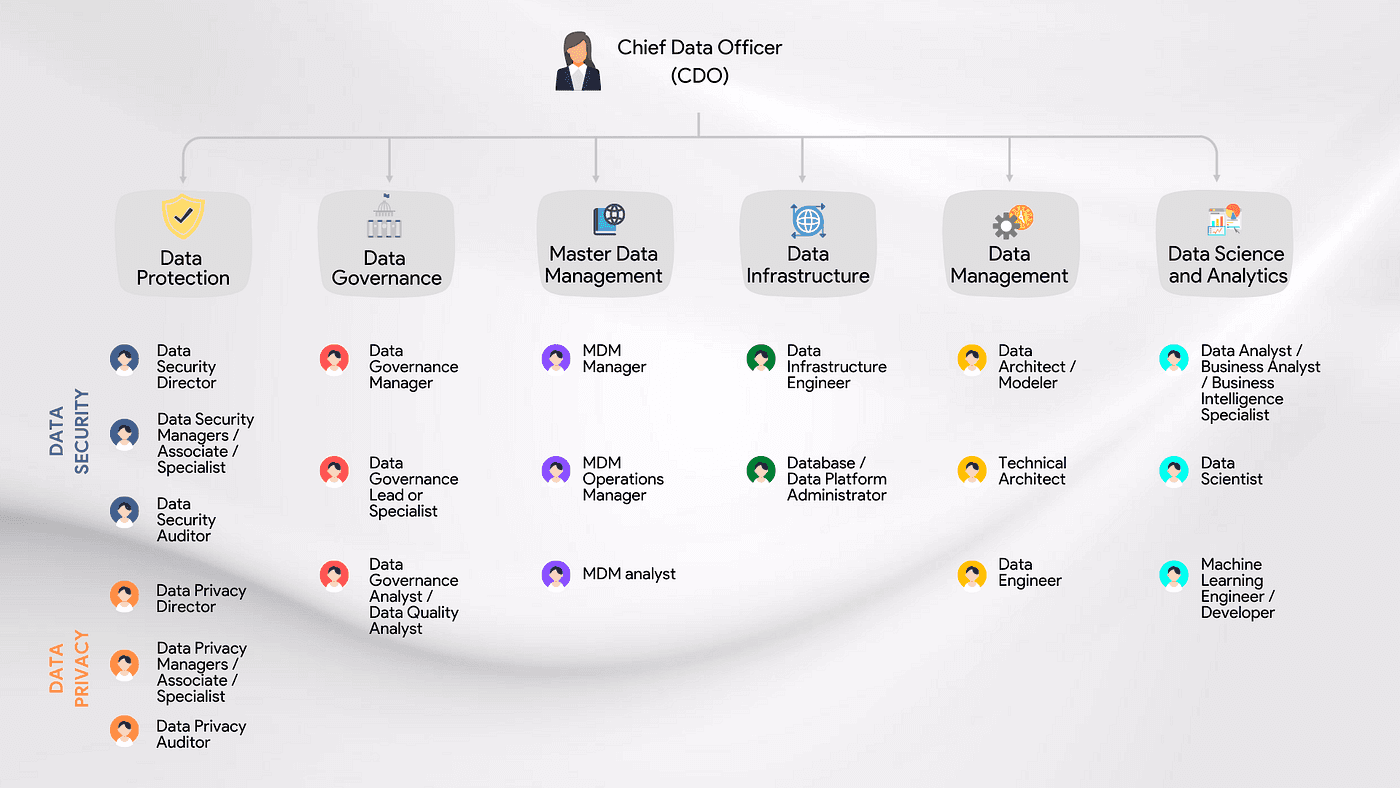
In case you were also unsure about the myriad of data roles out there hopefully now you have a better understanding of how the data field works, including the individual roles you might find in a data team.
Please do let me know in the comments below if you think I missed any key area or role in a data organization.
I hope you enjoyed this article. Ciao for now and see you in the next one!